Registration for the 2026-2027 school year is now open!
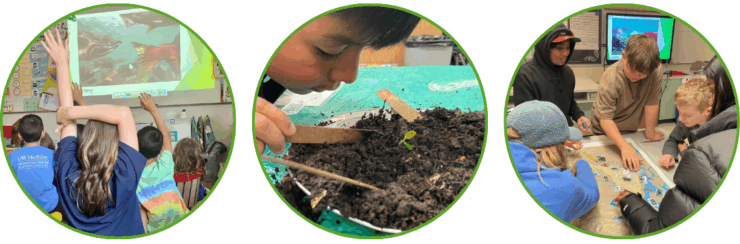
We offer water conservation classroom programs for students in grades kindergarten through eighth grade in our service area. The programs are free to schools whose water utility is a member of the Saving Water Partnership (find out if your school’s water utility is a member using our lookup tool).
All lessons are taught by Nature Vision, an environmental education nonprofit organization the brings place-based, experiential nature programming directly to schools. Nature Vision’s goal is to foster appreciation and stewardship of our environment by educating and connecting community to the world around is. They provide in-classroom and remote programs to ensure that all students receive quality nature connections where they need them most.
Our educational programs:
- Include interactive, hands-on, and inquiry-based activities
- Help students make personal connections to environmental issues
- Support Washington State K-12 Learning Standards and STEM education, allowing for easy integration into schools


Learn more about our different program offerings:
Elementary School Programs
Water Cycle Terrariums [Grades K-3]*
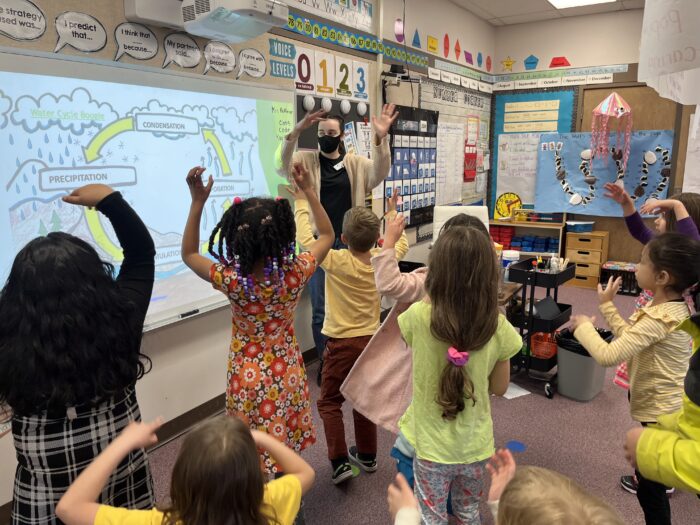
Students will explore the water cycle, learn how water moves through the watersheds where our drinking water comes from, and actions we can all take to save water. Program activities include dancing to the water cycle boogie and making a terrarium (complete with a dinosaur!) that models the water cycle.
Water Cycles Round [Grades 4-5]*
Students will review the water cycle, learn how water moves through the watersheds where our drinking water comes from, and actions we can all take to save water. Program activities include a game where students become water droplets and travel to all the places that water goes during the water cycle— rivers, clouds, oceans and more!
Healthy Soil Saves Water [Grades K-3]
Students will learn all about soil and discover how building healthy soil with compost can help save water. Program activities include hands-on exploration of organic material and the decomposers that live in soil—including the charismatic red wriggler worm!
Healthy Soil Saves Water [Grades 4-5]
Students will learn all about soil, its role supporting ecosystems and food webs, and discover how building healthy soil with compost can help save water. Program activities include a demonstration of water retention in different soil types and hands-on exploration of organic material and the decomposers that live in soil.
Salmon Cycle [Grades K-3]*
Students are introduced to the unique life cycle of Pacific salmon, observe salmon eggs at various stages of development, and learn how saving water can benefit salmon. Program activities include demonstrating the salmon lifecycle with puppets and working in teams to build a salmon redd (nest)!
Salmon Cycle [Grades 4-5]*
Students are introduced to the unique life cycle of Pacific salmon, explore salmon’s important role as a keystone species in Pacific Northwest ecosystems, and learn how saving water can benefit salmon. Program activities include working in teams to map connections between salmon, humans, and the ecosystem we share.
Will There Be Enough Water? [Grades 4-5]*
Students will learn about the local watersheds that supply our drinking water – including the earth processes and human choices that impact our water supply. Program activities include answering the question, ‘Will there be enough water?’ by working in teams to model our water supply throughout the year under different conditions.
Water Conservation Town Hall [Grades 4-5]*
Students will learn that water is an important resource shared by individuals, communities, and ecosystems. Program activities include a mock town hall meeting where students will role-play different stakeholder groups trying to decide how to manage their community’s water resources.
Middle School Programs

Salmon Cycle [Grades 6-8]*
Students review the unique life cycle of Pacific salmon, explore salmon’s important role as a keystone species in Pacific Northwest ecosystems, and learn how saving water can benefit salmon. Program activities include applying knowledge gained during the program to interpret an excerpt from the Puget Sound Salmon Recovery Plan and working in teams to map connections between salmon, humans, and ecosystems.
Soil Science and Water Conservation [Grades 6-8]
Students will learn about soil formation, how soil type affects plants, and discover how building healthy soil with compost can help save water. Program activities include working in teams to use scientific inquiry to test water retention in different soil types.
Will There Be Enough Water? [Grades 6-8]*
Students will learn about the local watersheds that supply our drinking water including the earth process and human choices that impact our water supply. Program activities include working in teams to model our water supply throughout the year to answer the question, ‘Will there be enough water?’ Students will also compare their conclusions to real-world data.
Water Conservation Town Hall [Grades 6-8]*
Students will learn that water is an important resource shared by individuals, communities, and ecosystems. Program activities include a mock town hall meeting where students will role-play different stakeholder groups trying to decide how to manage their community’s water resources.
*Program is also available virtually
